> ## Documentation Index
> Fetch the complete documentation index at: https://utter.to/docs/llms.txt
> Use this file to discover all available pages before exploring further.
# Shortcuts & Automation
> Control Utter from other apps with macOS completion commands, URL schemes, and iOS Shortcuts
Use automation to send Utter output to other apps, start or stop recording, and build hands-free workflows.
## iOS Shortcuts
Use iOS Shortcuts to start or stop recording without opening Utter.
### Fastest setup: use this ready-made shortcut
 Start/stop recording with one button and copy to clipboard
This shortcut is the easiest way to use Utter hands-free:
* Press once to start recording.
* Press the same button or trigger again to stop recording.
* The transcript is copied to your clipboard automatically.
* You do not need to open Utter or the Shortcuts app.
Bind it to an iPhone trigger like **Action Button** or **Back Tap** (double tap on the back of your phone) for quick one-button dictation.
### Available Utter Shortcut Actions
| Shortcut Action | Optional `Mode` Parameter | Behavior |
| ---------------- | ------------------------- | ----------------------------------------------------------------------------------------------- |
| Start Recording | Yes | Starts recording. If `Mode` is not set, Utter uses the last used mode. |
| Stop Recording | No | Stops recording and completes transcription. |
| Toggle Recording | Yes | Starts or stops recording with one action. If `Mode` is not set, Utter uses the last used mode. |
## macOS Completion Commands
On macOS, each mode can run a completion command after transcription finishes.
Use completion commands when you want Utter to send the final transcript to another app or script automatically. For example, you can append each finished dictation to your Obsidian daily note with the Obsidian CLI.
Start/stop recording with one button and copy to clipboard
This shortcut is the easiest way to use Utter hands-free:
* Press once to start recording.
* Press the same button or trigger again to stop recording.
* The transcript is copied to your clipboard automatically.
* You do not need to open Utter or the Shortcuts app.
Bind it to an iPhone trigger like **Action Button** or **Back Tap** (double tap on the back of your phone) for quick one-button dictation.
### Available Utter Shortcut Actions
| Shortcut Action | Optional `Mode` Parameter | Behavior |
| ---------------- | ------------------------- | ----------------------------------------------------------------------------------------------- |
| Start Recording | Yes | Starts recording. If `Mode` is not set, Utter uses the last used mode. |
| Stop Recording | No | Stops recording and completes transcription. |
| Toggle Recording | Yes | Starts or stops recording with one action. If `Mode` is not set, Utter uses the last used mode. |
## macOS Completion Commands
On macOS, each mode can run a completion command after transcription finishes.
Use completion commands when you want Utter to send the final transcript to another app or script automatically. For example, you can append each finished dictation to your Obsidian daily note with the Obsidian CLI.
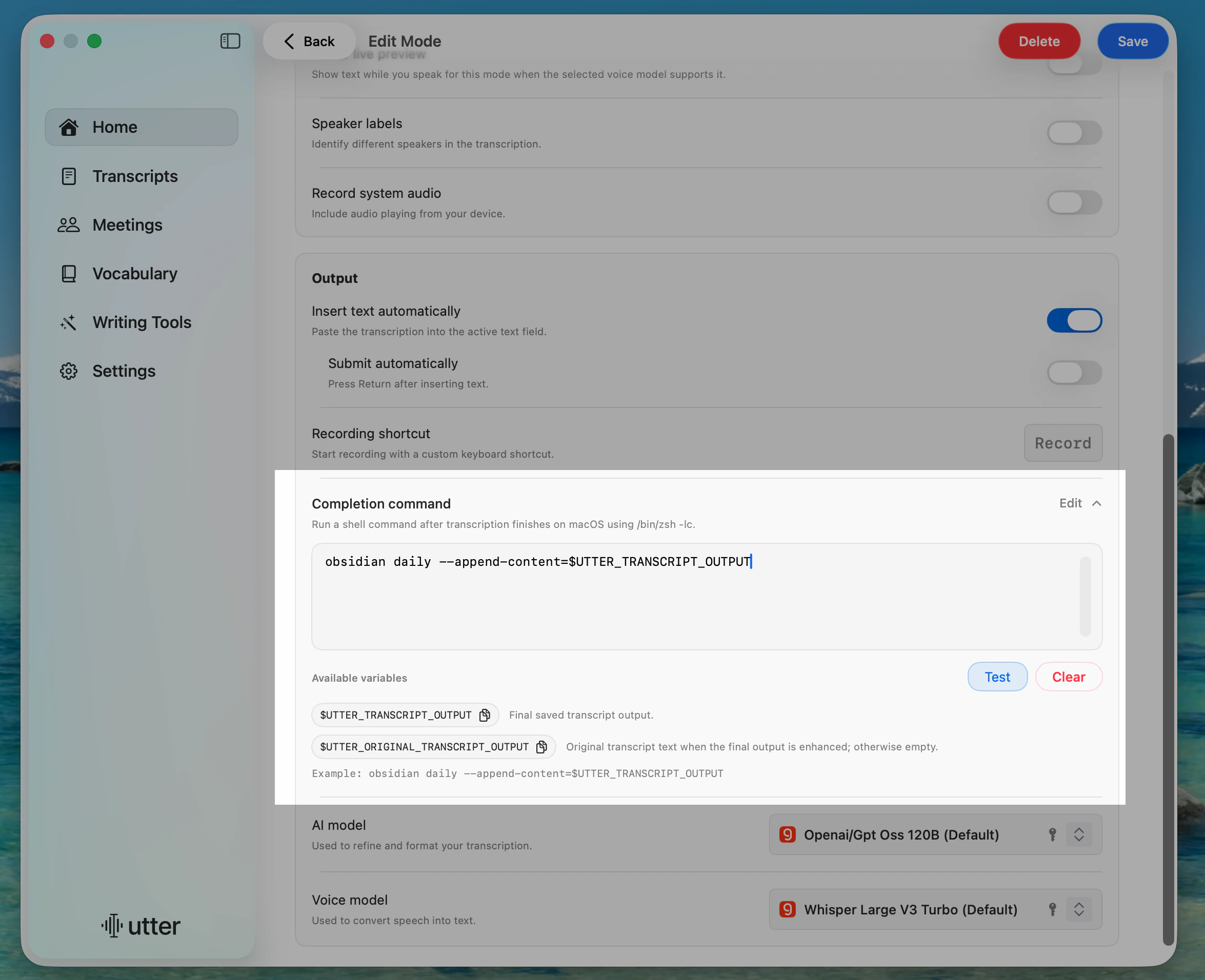 Completion commands run shell commands on your Mac. Only use commands you trust.
### Add a Completion Command
In Utter, go to **Home**.
Select the mode you want to automate.
In **Output**, open **Completion command** and click **Edit**.
Add the shell command you want Utter to run after transcription.
Click **Test**, then click **Save**.
**What to expect:** After that mode finishes transcribing, Utter runs the command using `/bin/zsh -lc`.
### Available Variables
Use these variables in your command:
| Variable | Meaning |
| ----------------------------------- | ---------------------------------------------------------------------------- |
| `$UTTER_TRANSCRIPT_OUTPUT` | Final saved transcript output. |
| `$UTTER_ORIGINAL_TRANSCRIPT_OUTPUT` | Original transcript text when the final output is enhanced; otherwise empty. |
### Example: Append to Obsidian
```bash theme={null}
obsidian daily --append-content=$UTTER_TRANSCRIPT_OUTPUT
```
## Dictation Controls
Control recording with these URLs:
| Action | URL |
| ---------------- | -------------------------- |
| Start recording | `utter://dictation/start` |
| Stop recording | `utter://dictation/stop` |
| Pause recording | `utter://dictation/pause` |
| Cancel recording | `utter://dictation/cancel` |
## Mode Switching
Switch to a specific mode:
```
utter://mode/set/{mode-name}
```
Mode names are converted to lowercase kebab-case (for example, `Voice to Text` becomes `voice-to-text`):
| Mode Name | URL |
| -------------- | --------------------------------- |
| Obsidian Notes | `utter://mode/set/obsidian-notes` |
| Email | `utter://mode/set/email` |
| Voice to Text | `utter://mode/set/voice-to-text` |
## Usage Examples
### Terminal
```bash theme={null}
open "utter://dictation/start"
```
### Shortcuts.app
Add an **Open URLs** action.
Enter a Utter URL (for example, `utter://dictation/start`).
Run the shortcut to trigger Utter.
**What to expect:** Utter runs the matching action immediately when the shortcut is executed.
**If that did not work:** Confirm Utter is installed and currently running before triggering the URL.
### Raycast / Alfred
Create a script or workflow that opens the URL:
```bash theme={null}
open "utter://mode/set/email"
open "utter://dictation/start"
```
### Keyboard Maestro
Use the **Open URL** action with any Utter deep link to trigger it from a macro.
Completion commands run shell commands on your Mac. Only use commands you trust.
### Add a Completion Command
In Utter, go to **Home**.
Select the mode you want to automate.
In **Output**, open **Completion command** and click **Edit**.
Add the shell command you want Utter to run after transcription.
Click **Test**, then click **Save**.
**What to expect:** After that mode finishes transcribing, Utter runs the command using `/bin/zsh -lc`.
### Available Variables
Use these variables in your command:
| Variable | Meaning |
| ----------------------------------- | ---------------------------------------------------------------------------- |
| `$UTTER_TRANSCRIPT_OUTPUT` | Final saved transcript output. |
| `$UTTER_ORIGINAL_TRANSCRIPT_OUTPUT` | Original transcript text when the final output is enhanced; otherwise empty. |
### Example: Append to Obsidian
```bash theme={null}
obsidian daily --append-content=$UTTER_TRANSCRIPT_OUTPUT
```
## Dictation Controls
Control recording with these URLs:
| Action | URL |
| ---------------- | -------------------------- |
| Start recording | `utter://dictation/start` |
| Stop recording | `utter://dictation/stop` |
| Pause recording | `utter://dictation/pause` |
| Cancel recording | `utter://dictation/cancel` |
## Mode Switching
Switch to a specific mode:
```
utter://mode/set/{mode-name}
```
Mode names are converted to lowercase kebab-case (for example, `Voice to Text` becomes `voice-to-text`):
| Mode Name | URL |
| -------------- | --------------------------------- |
| Obsidian Notes | `utter://mode/set/obsidian-notes` |
| Email | `utter://mode/set/email` |
| Voice to Text | `utter://mode/set/voice-to-text` |
## Usage Examples
### Terminal
```bash theme={null}
open "utter://dictation/start"
```
### Shortcuts.app
Add an **Open URLs** action.
Enter a Utter URL (for example, `utter://dictation/start`).
Run the shortcut to trigger Utter.
**What to expect:** Utter runs the matching action immediately when the shortcut is executed.
**If that did not work:** Confirm Utter is installed and currently running before triggering the URL.
### Raycast / Alfred
Create a script or workflow that opens the URL:
```bash theme={null}
open "utter://mode/set/email"
open "utter://dictation/start"
```
### Keyboard Maestro
Use the **Open URL** action with any Utter deep link to trigger it from a macro.