Best Dictation Software 2026: 10 Apps Compared
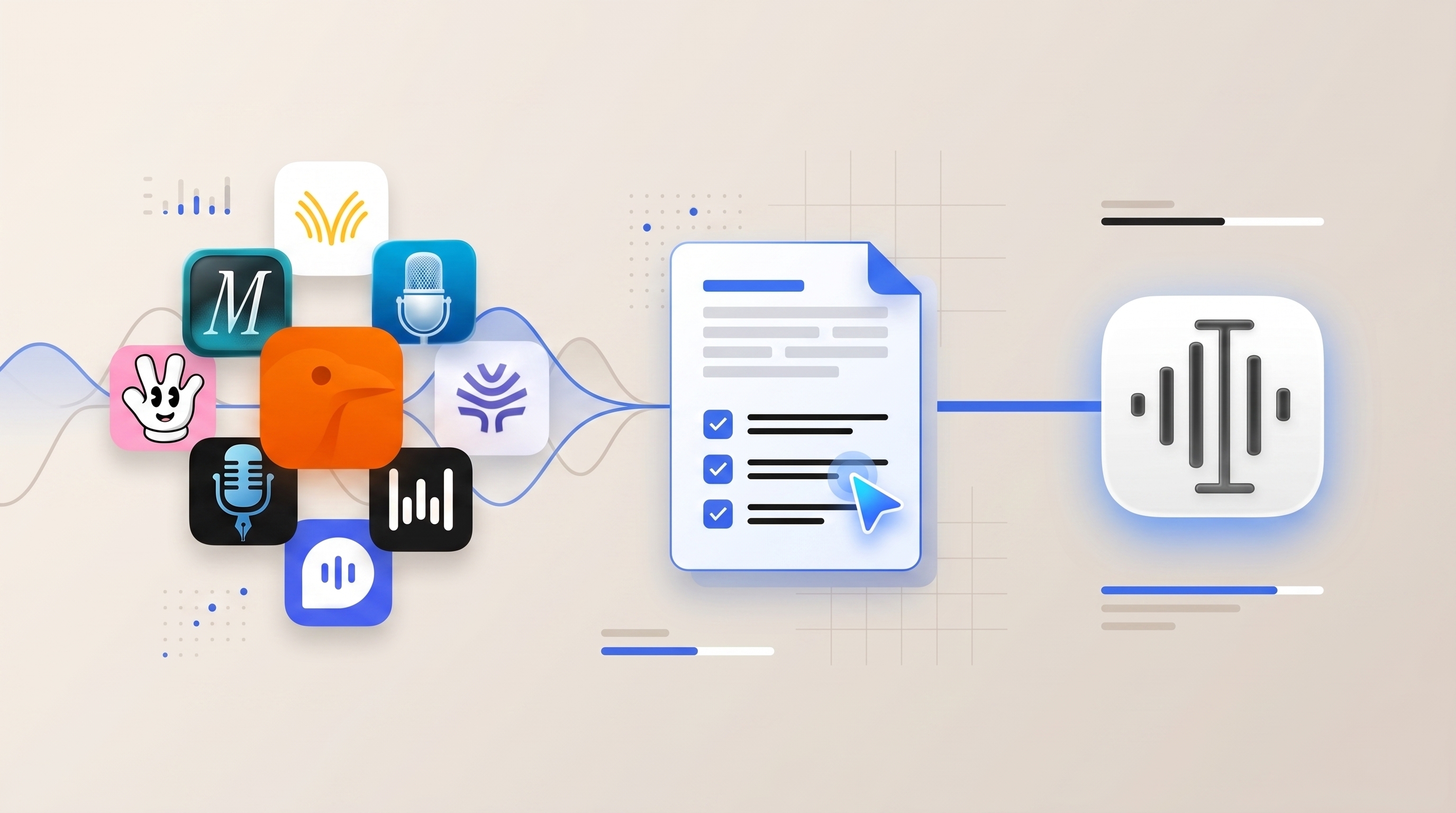
A ranked comparison of the best dictation software in 2026, with direct Utter comparison guides for Wispr Flow, Superwhisper, VoiceInk, MacWhisper, Handy, Monologue, Aqua Voice, Willow Voice, Voibe, BetterDictation, SpeakMac, and Voicy.
Updated
Best Dictation Software 2026: 10 Apps Compared
Dictation software is no longer just a microphone button in the corner of an operating system. The best voice typing apps now combine accurate speech recognition, cleanup prompts, local models, cloud model routing, searchable history, and workflow-specific formatting.
This guide focuses on dictation and voice typing: press a shortcut, speak, and put text where your cursor already is. Meeting transcription tools appear only when they also matter for day-to-day writing workflows.
What is dictation software?
Dictation software converts speech into text while you write. In practical use, that means pressing a keyboard shortcut or microphone button, speaking naturally, and inserting text into an app such as email, chat, notes, docs, an IDE, or an AI prompt box. The best modern dictation apps also clean up punctuation, formatting, tone, and structure after transcription.
TL;DR Ranking
- Utter - best overall dictation software for Mac and iPhone users who want polished output, offline options, BYOK, history, and meeting/file workflows in one app.
- Wispr Flow - best broad cross-platform option for teams that need Mac, Windows, iPhone, and Android coverage.
- Superwhisper - best Mac-first privacy pick for users who want a mature hotkey dictation workflow.
- Willow Voice - best communication-first cloud dictation app for teams that want shared dictionaries and admin controls.
- Aqua Voice - best for AI rewriting and context-aware voice input.
- MacWhisper - best for local file transcription with some system-wide dictation support.
- VoiceInk - best lightweight offline option for Mac and iPhone users.
- Apple Dictation - best free baseline for Mac users.
- Windows Voice Typing - best free baseline for Windows users.
- whisper.cpp - best open-source engine for technical teams building their own local stack.
The 10 Best Dictation Apps of 2026
1. Utter - Best Overall
Price: Free tier, Pro at $5.99/month or $59.99/year (Utter pricing)
Platforms: Mac and iPhone
Best for: Apple-first users who want fast dictation, polished text, local/private options, BYOK, transcript history, and meeting/file workflows
Utter is the strongest overall pick because it treats dictation as a full writing workflow, not just raw speech-to-text. It works anywhere you can type, supports a global shortcut on Mac, inserts text at the cursor, and can turn spoken input into emails, notes, chat messages, summaries, and custom formats through AI modes (Utter docs).
The bigger difference is control. Utter documents a fully local setup for transcription and AI post-processing, including local Parakeet transcription and local OpenAI-compatible AI processing through LM Studio or Ollama (local guide). It also supports BYOK, so users can bring their own speech-to-text and AI provider keys without paying Utter usage fees for those routes (BYOK docs).
Utter also covers adjacent workflows that many dictation apps skip: searchable voice history, file transcription, speaker-labeled meeting transcripts, note editing, and exports for handoff formats. That makes it a better fit when voice input needs to become reusable work, not just a one-off message.
Pros
- Works in any app where you can type, with Mac global shortcut support.
- Local/offline path and BYOK path are available.
- AI modes help convert rough speech into polished text.
- Searchable history syncs across Mac and iPhone.
- Meeting, file transcription, speaker labels, and export workflows are available.
- Public pricing is lower than several direct cloud-first competitors.
Cons
- Not the right first pick for Windows-only or Android-only workflows.
- Local processing quality and speed depend on supported hardware and model choice.
- Enterprise admin controls are less prominent than in team-first tools.
Buyer-fit takeaway: Start with Utter if you use Mac or iPhone and care about total writing throughput: dictation, cleanup, history, privacy options, and downstream transcript workflows.
Related reads: Use Utter for free, Utter vs Wispr Flow, and Utter vs Superwhisper.
Direct Utter Comparison Guides
Use these detailed comparisons when you already have a shortlist. Each guide covers pricing posture, platform fit, privacy model, workflow depth, and when the competitor may still be the better choice.
| App | Direct comparison | Best fit to evaluate |
|---|---|---|
 Wispr Flow Wispr Flow | Utter vs Wispr Flow | Mixed-platform teams and cross-device rollout |
 Superwhisper Superwhisper | Utter vs Superwhisper | Focused local-first hotkey dictation |
 VoiceInk VoiceInk | Utter vs VoiceInk | Open-source local dictation and context switching |
 MacWhisper MacWhisper | Utter vs MacWhisper | Batch file transcription and media workflows |
 Handy Handy | Utter vs Handy | Hackable local-only desktop dictation |
 Monologue Monologue | Utter vs Monologue | Context-aware formatting and Apple Watch dictation |
 Aqua Voice Aqua Voice | Utter vs Aqua Voice | Low-latency cloud dictation and jargon handling |
 Willow Voice Willow Voice | Utter vs Willow Voice | Communication-first team dictation |
 Voibe Voibe | Utter vs Voibe | English-only developer dictation |
 BetterDictation BetterDictation | Utter vs BetterDictation | Filler-word cleanup and clean transcription |
 SpeakMac SpeakMac | Utter vs SpeakMac | Minimal local speech-to-text with snippets |
 Voicy Voicy | Utter vs Voicy | Browser-friendly cloud dictation |
2. Wispr Flow - Best Cross-Platform Team Option
Price: Free Basic, Pro listed at $15/user/month monthly or $12/user/month billed annually (pricing)
Platforms: Mac, Windows, iPhone, and Android
Best for: Users and teams that need one dictation app across mixed operating systems
Wispr Flow is the strongest pick when platform coverage is the gating requirement. Its pricing page lists desktop support for Mac and Windows, plus iPhone and Android support, with Free, Pro, and Enterprise plan paths (pricing).
Flow is also built for team rollout. The Pro plan includes team collaboration features such as shared dictionary and snippets, while Enterprise adds controls such as SSO/SAML, admin controls, compliance positioning, and advanced dashboards (pricing). Wispr also publishes privacy and compliance material around Privacy Mode, zero dictation data retention when enabled, SOC 2 Type II, ISO 27001, and HIPAA positioning (privacy).
The tradeoff is processing model. Wispr Flow is cloud-only, so it is not a local/offline-first product in the same way as tools built around on-device models.
Pros
- Broad platform coverage across Mac, Windows, iPhone, and Android.
- Free tier with 2,000 words per week.
- Team and Enterprise paths are available.
- Shared dictionary, snippets, and admin controls are useful for rollout.
- Public pricing and security/compliance information are available.
Cons
- Not positioned as a local/offline-first app.
- No BYOK.
- No file transcription.
- Pro pricing is higher than Utter’s individual plan.
- Team features may be more than an individual buyer needs.
Buyer-fit takeaway: Pick Wispr Flow when cross-platform coverage and team governance matter more than local-first control.
3. Superwhisper - Best Mac-First Privacy Pick
Price: Free tier, paid Pro pricing shown on vendor pricing surfaces
Platforms: macOS, iOS, and Windows
Best for: Mac-first users who want a polished hotkey dictation loop and local model flexibility
Superwhisper is a strong choice for users who want a focused voice-to-text workflow across apps. Its homepage describes selecting an app, pressing a shortcut, and dictating into Slack, Gmail, or other apps. The App Store listing also emphasizes polished output, modes, custom presets, BYOK, and recording history for iPhone users (App Store).
Superwhisper’s main appeal is the power-user path: local dictation, modes, presets, and provider/model flexibility. For privacy-sensitive users, it deserves a direct test against Utter, especially if the buyer is optimizing for latency and local behavior above meeting or export workflows.
The practical tradeoff is scope. Superwhisper is excellent as a dictation layer, but Utter is stronger when the same buyer wants dictation plus searchable history, meeting recording, speaker editing, file workflows, and exports in one product.
Pros
- Mature hotkey dictation workflow.
- Strong fit for Mac-first and iPhone users.
- Custom modes and BYOK appear in official App Store product text.
- Good option for users who like local/private dictation workflows.
Cons
- Less focused on broader transcript lifecycle workflows than Utter.
- BYOK requires a paid plan.
- Free local models are limited to smaller models than Utter’s free local options.
Buyer-fit takeaway: Choose Superwhisper when you want a focused dictation tool and are willing to compare workflow depth against Utter in your own apps.
4. Willow Voice - Best Communication-First Cloud Dictation
Price: Free plan, Individual Pro listed at $15/month with annual discount; Team and Enterprise plans available (pricing)
Platforms: Mac, Windows, iOS, with Android listed as coming soon in help docs and present on pricing comparison surfaces
Best for: Teams and individuals who mostly dictate emails, chat, docs, and business communication
Willow Voice is built around everyday communication. Its pricing and help materials list Free, Individual, Team, and Enterprise paths, with features such as context awareness, smart correction and formatting, dictionaries, transcript history, and privacy mode (help center).
Willow becomes more interesting for teams because its Team and Enterprise paths include centralized billing, shared team dictionary, team management dashboard, SOC 2, HIPAA, zero data retention, SSO/SAML, and admin privacy controls on official pricing/help surfaces (pricing).
The tradeoff is that Willow is cloud-service oriented. That can be ideal for business messaging, but it is less compelling if your main requirement is local/offline dictation or BYOK cost control.
Pros
- Clear plan ladder from Free to Enterprise.
- Mac, Windows, and iOS support.
- Strong team features for shared vocabulary and management.
- Privacy mode and enterprise security controls are visible in official materials.
Cons
- Not positioned as a local/offline-first tool.
- No BYOK.
- No file transcription.
- Users who need transcript exports and meeting workflows should compare against Utter.
Buyer-fit takeaway: Pick Willow when your main job is business communication and your team values shared vocabulary, account management, and cloud convenience.
5. Aqua Voice - Best for AI Rewriting
Price: 1,000 free words one time, Pro listed at $8/month billed annually on the website; iOS App Store subscriptions are listed separately (Aqua Voice)
Platforms: Mac, Windows, and iOS
Best for: Users who want voice input aggressively refined into polished output
Aqua Voice is strongest when the buyer wants the app to actively rewrite and refine spoken input. Its homepage emphasizes working in every app, custom dictionary, custom prompting, 49 languages, transcript history, and its Avalon model. Its pricing section lists 1,000 free words one time, Pro at $8/month billed annually, and Team at $12/month billed annually (Aqua Voice).
The iOS App Store listing positions Aqua as a voice keyboard for AI workflows and business communication, with in-app purchase prices shown separately by Apple (App Store). Desktop/web pricing and iOS pricing may use different purchase surfaces.
Aqua’s tradeoff is control. It is compelling when you want the system to shape text for you, but aggressive rewriting can be a risk when exact wording matters.
Pros
- Strong AI rewriting and custom prompting angle.
- Mac, Windows, and iOS surfaces.
- Custom dictionary and transcript history are part of the public feature set.
- Team pricing and org-wide privacy mode are visible on the homepage.
Cons
- Heavier AI rewriting can alter exact wording.
- Pricing differs by purchase surface, especially iOS.
- Cloud-only processing.
- No BYOK or file transcription.
Buyer-fit takeaway: Choose Aqua when clean, rewritten output is the main priority and AI-polished text fits your workflow.
6. MacWhisper - Best for Local File Transcription
Price: Free version, Pro as a one-time upgrade with current rate shown through vendor/Gumroad surfaces
Platforms: macOS and iOS
Best for: Users who primarily transcribe files, recordings, meetings, and videos locally
MacWhisper is primarily a local transcription app rather than a pure dictation tool. Its homepage emphasizes on-device transcription, audio/video file workflows, YouTube transcription, exports, speaker recognition, integrations, and a one-time Pro upgrade model.
For journalists, creators, researchers, and anyone working with recorded files, MacWhisper is a serious option. It runs transcription locally by default according to its official FAQ, which is valuable for sensitive files (MacWhisper).
The tradeoff is live dictation depth. MacWhisper includes basic system-wide dictation, but buyers who spend most of the day dictating into chat, docs, email, and prompts should compare it with Utter, Wispr Flow, Superwhisper, and Willow.
Pros
- Strong local file transcription workflow.
- Free tier plus one-time Pro upgrade path.
- Export and batch/file features are more prominent than in many dictation apps.
- Useful for audio, video, YouTube, and meeting files.
Cons
- System-wide dictation is not the main product focus.
- Current Pro price should be confirmed at purchase time.
- Less suited to fast live writing than dedicated dictation apps.
Buyer-fit takeaway: Pick MacWhisper when your main input is existing audio or video files, not daily cursor-level dictation.
7. VoiceInk - Best Lightweight Offline Mac and iPhone Option
Price: Free tier, Pro listed at $69/year on the vendor homepage (VoiceInk)
Platforms: Mac and iPhone
Best for: Mac and iPhone users who want simple dictation with offline free use
VoiceInk is a focused Mac and iPhone dictation app. Its product materials describe pressing a shortcut, speaking, and inserting text into text fields. The Free tier runs locally on the device using Whisper, with no internet requirement, BYOK is available for free, and Pro adds live real-time transcription through Deepgram.
VoiceInk is not trying to be a full writing suite. That is part of the appeal: if you use Mac or iPhone and want a lightweight offline-first dictation app, it is easy to understand and test.
The tradeoff is workflow breadth. It does not appear to target the same history, meeting, file transcription, export, and note workflow depth as Utter, and it does not appear to target enterprise admin workflows.
Pros
- Free tier.
- Free BYOK support.
- Mac and iPhone support.
- Custom vocabulary and model controls are visible on the homepage.
- Pro live transcription path is clearly explained.
Cons
- Narrower workflow breadth than full voice-workflow tools.
- Pro uses cloud transcription for live real-time mode.
- Less workflow depth than tools with history, meeting, export, and AI mode ecosystems.
Buyer-fit takeaway: Choose VoiceInk if you are on Mac or iPhone and want simple offline dictation before evaluating broader workflow tools.
8. Apple Dictation - Best Free Mac Baseline
Price: Included with macOS
Platforms: Mac
Best for: Short free dictation tests before choosing a dedicated app
Apple Dictation is the baseline every Mac user should test. Apple’s support page says Dictation lets users speak to enter text anywhere they can type it, with settings showing whether general text dictation is processed on-device or needs an internet connection.
Apple Dictation is useful because it costs nothing and is already available. It can be enough for short messages, quick notes, and basic accessibility needs.
The tradeoff is workflow depth. It does not give users the same level of app-specific formatting, BYOK control, transcript history, local/cloud switching, or meeting/file lifecycle features as dedicated apps.
Pros
- Free and built into macOS.
- Works anywhere text can be typed.
- Good baseline for short messages and simple notes.
- No new vendor account required.
Cons
- Advanced processing depends on platform, language, and settings.
- Limited custom formatting and AI mode control.
- No dedicated BYOK, transcript history, or team workflow layer.
Buyer-fit takeaway: Use Apple Dictation as the free benchmark, then upgrade if cleanup, privacy control, history, or long-form reliability become bottlenecks.
9. Windows Voice Typing - Best Free Windows Baseline
Price: Included with Windows
Platforms: Windows
Best for: Windows users who need built-in voice typing without buying software
Windows Voice Typing is Microsoft’s built-in voice typing feature. Microsoft documents the shortcut Windows logo key + H, punctuation controls, and voice typing settings.
It is the best first test for Windows users because it is already there. If the job is occasional text entry, it may be enough.
The tradeoff is specialization. Dedicated tools usually add stronger workflows for dictionaries, custom output formats, local model choices, history, and AI cleanup.
Pros
- Included with Windows.
- Fast to test with no extra app purchase.
- Useful for baseline dictation in common text fields.
- Microsoft documentation is clear and easy to follow.
Cons
- Not a dedicated AI writing workflow.
- Limited BYOK, prompt, and model control.
- Privacy and processing behavior should be reviewed in Windows settings and Microsoft docs before sensitive use.
Buyer-fit takeaway: Start with Windows Voice Typing if you need free Windows dictation, then move to a dedicated app when formatting and workflow control matter.
10. whisper.cpp - Best Open-Source Engine
Price: Free open-source project
Platforms: Depends on your build and deployment target
Best for: Developers and technical teams building their own local transcription stack
whisper.cpp is not a polished consumer dictation app. It is an open-source C/C++ implementation around Whisper-style local transcription that technical users can build into their own workflows.
It belongs in the ranking because some buyers do not want another app at all. They want an engine they can run, script, deploy, or embed. For those teams, whisper.cpp can be the correct starting point.
The tradeoff is obvious: you are responsible for everything around the engine. That includes installation, model management, hotkeys, text insertion, privacy review, UI, support, and workflow polish.
Pros
- Open-source local transcription path.
- Strong fit for developers and internal tooling teams.
- No subscription fee for the project itself.
- Flexible for custom pipelines.
Cons
- Not a consumer-ready dictation app by itself.
- Requires technical setup and ongoing maintenance.
- No built-in polished writing workflow, app insertion layer, or support team.
Buyer-fit takeaway: Choose whisper.cpp only if you want to build or operate your own transcription workflow rather than buy a finished dictation app.
Quick Comparison Table
| App | Price | Platforms | Offline/local support | BYOK | Best fit |
|---|---|---|---|---|---|
| Utter | Free, Pro $5.99/mo or $59.99/yr | Mac, iPhone | Yes, local path | Yes | Best overall for Apple-first dictation workflows |
| Wispr Flow | Free 2,000 words/week; Pro $15/mo or $12/mo annual | Mac, Windows, iPhone, Android | Cloud only | No | Mixed-platform teams |
| Superwhisper | Free + paid Pro + $250 lifetime | macOS, iOS, Windows | Hybrid | Paid plan required | Mac-first hotkey dictation |
| Willow Voice | Free, Individual Pro $15/mo with annual discount | Mac, Windows, iOS | Cloud only | No | Team communication |
| Aqua Voice | 1,000 free words once, Pro $8/mo billed annually | Mac, Windows, iOS | Cloud only | No | AI rewriting and polished messages |
| MacWhisper | Free, Pro one-time upgrade | macOS, iOS | Hybrid | Paid plan required | File transcription |
| VoiceInk | Free, Pro $69/yr | Mac, iPhone | Hybrid | Yes | Lightweight Mac and iPhone dictation |
| Apple Dictation | Included | Mac | Depends on settings/language | No | Free Mac baseline |
| Windows Voice Typing | Included | Windows | Review Microsoft settings/docs | No | Free Windows baseline |
| whisper.cpp | Free open source | Build-dependent | Yes | Build-dependent | Developer-owned local stack |
Use-Case Fit Matrix
| Use case | Start with | Compare against | Why |
|---|---|---|---|
| Best dictation app for Mac | Utter | Superwhisper, Apple Dictation | Utter combines any-app dictation, AI modes, local setup, BYOK, and history. |
| Mixed Mac, Windows, iPhone, Android team | Wispr Flow | Willow Voice | Broad platform coverage and team controls matter more than local-only workflows. |
| Communication-heavy team writing | Willow Voice | Aqua Voice, Wispr Flow | Shared dictionaries, admin features, and communication-oriented output are the main value. |
| AI-polished messages and rewriting | Aqua Voice | Utter | The main test is whether rewritten output preserves meaning while reducing cleanup. |
| Local file transcription | MacWhisper | Utter, whisper.cpp | File imports, exports, and local recording workflows matter more than live cursor insertion. |
| Free baseline | Apple Dictation or Windows Voice Typing | Utter free/BYOK setup | Built-in tools validate the habit before a paid app is needed. |
| Developer-owned local stack | whisper.cpp | Utter local setup | Teams can choose between building a stack and using a finished app with local options. |
How We Ranked
Dictation quality and workflow fit
The highest-ranked tools are purpose-built for live dictation into real apps, not just file transcription. Utter ranks first because it combines any-app dictation with output modes, history, local/cloud control, BYOK, and transcript workflows.
Privacy and offline support
Apps with local, offline, or hybrid paths ranked higher than cloud-only tools for sensitive work. Utter, Superwhisper, MacWhisper, VoiceInk, Apple Dictation, and whisper.cpp all have local or on-device paths, but they differ sharply in polish and workflow breadth.
Pricing and BYOK
Free baselines are valuable, but heavy users should compare ongoing cost and model control. BYOK matters because it can route usage through providers the buyer already pays for. Utter ranks highly here because its BYOK path is available without Utter usage fees.
Platform coverage
Wispr Flow ranks high for broad platform support. Utter ranks first despite narrower platform coverage because the article is weighted toward the best complete dictation experience, not only the largest device matrix.
Post-processing and workflow depth
Modern dictation software should help speech become usable text. Modes, custom prompts, dictionaries, history, meeting notes, file transcription, and exports all matter because cleanup time is often the hidden cost of voice typing.
Hands-On Evaluation Protocol
Use the same test script in every app:
Please write a short update for the product channel: we finished the dictation test, local mode passed the policy checklist, and support needs feedback by Friday.1. Latency
Dictate the script into notes, email, chat, and a browser text field. Observe whether text appears while you speak or only after you stop. Repeat once on stable Wi-Fi and once on a weaker connection.
2. Correction
Add product names, acronyms, punctuation, and a short list. Measure how much manual editing is needed before the result can be sent.
3. Compatibility
Run the same shortcut in your actual writing stack: docs, Slack, email, browser apps, IDEs, and AI tools. Watch for focus changes, clipboard issues, duplicate insertion, or dropped text.
4. Privacy
For privacy-sensitive teams, compare the privacy, local-processing, and pricing pages side by side. The core criteria are offline behavior, audio or transcript retention, and whether privacy mode or BYOK changes routing.
5. Terminology
Test proper nouns, customer names, technical terms, medication names, legal phrases, or any vocabulary your work depends on. A dictation app that handles your terms with less correction will usually save more time than a generic benchmark winner.
How to Choose Dictation Software in 2026
1. Decide whether you need local/offline dictation
If privacy, travel, or restricted-network work matters, start with tools that document local processing. For Mac and iPhone users, that puts Utter’s local guide near the top of the evaluation list.
2. Test the exact apps where you write
Run the same paragraph in email, Slack, docs, notes, and your coding or AI tools. Watch for text insertion reliability, focus problems, formatting surprises, and correction time.
3. Compare cleanup effort, not just raw accuracy
The best dictation app is the one that produces usable text fastest. A tool that rewrites your speech into the right structure may save more time than a tool that only returns a raw transcript.
4. Compare BYOK before paying for cloud usage
If you already use OpenAI, Deepgram, OpenRouter, or another provider, BYOK can lower cost and improve control. Utter documents BYOK for both speech-to-text and AI processing providers (BYOK docs).
5. Match platform coverage to your real devices
Do not overbuy for platforms you do not use. If you are Mac and iPhone only, Utter is the stronger first test. If your team is split across Mac, Windows, iPhone, and Android, Wispr Flow or Willow may be easier to standardize.
Frequently Asked Questions
What is the best dictation software for Mac in 2026?
Utter is the best dictation software for most Mac users in 2026 because it combines any-app dictation, global shortcuts, AI modes, local/offline processing, BYOK, searchable history, and Mac plus iPhone sync. Superwhisper is the closest alternative for Mac-first users who want a focused hotkey dictation app.
What is the best free dictation software?
The best free starting points are Apple Dictation on Mac and Windows Voice Typing on Windows. For a dedicated app, Utter is the best free first test for Mac and iPhone users because it supports free local usage and BYOK workflows (Use Utter for free).
Which dictation apps work offline?
Utter documents a local/offline setup. Superwhisper, MacWhisper, and VoiceInk are hybrid. Apple Dictation can be on-device depending on settings and language, and whisper.cpp can run locally for technical users.
What is BYOK and why does it matter?
BYOK means bring your own key. Instead of paying only through an app’s bundled cloud plan, you connect your own provider keys for speech-to-text or AI processing. This matters for cost control, vendor control, and advanced model routing. Utter documents BYOK for speech-to-text providers and AI processing providers (BYOK docs).
Is Apple Dictation good enough?
Apple Dictation is good enough for short, simple dictation and is the right free baseline for Mac users. Dedicated apps become more useful when you need custom formatting, AI cleanup, history, local/cloud routing, BYOK, longer workflows, or better control over how speech becomes final text.
How much should dictation software cost?
Start free if you can. Free built-in dictation is enough to validate the habit. Paid dedicated tools usually make sense when they save cleanup time, unlock local or cloud model choices, support your devices, and fit your privacy requirements. As of May 10, 2026, Utter Pro is listed at $5.99/month or $59.99/year on the Utter homepage, while several cloud/team-focused competitors publish higher individual or team-oriented pricing.
Try Utter First
If you use Mac or iPhone, start with Utter before paying for another dictation app. It gives you the strongest mix of any-app voice typing, polished output modes, local/offline options, BYOK, searchable history, and transcript workflows.
Source Notes
Pricing, platform support, and plan packaging were checked on May 10, 2026 using official vendor pages where available, including Utter, Wispr Flow, Willow Voice, and Aqua Voice.